Driving Sustainable Growth Through Environmental Stewardship
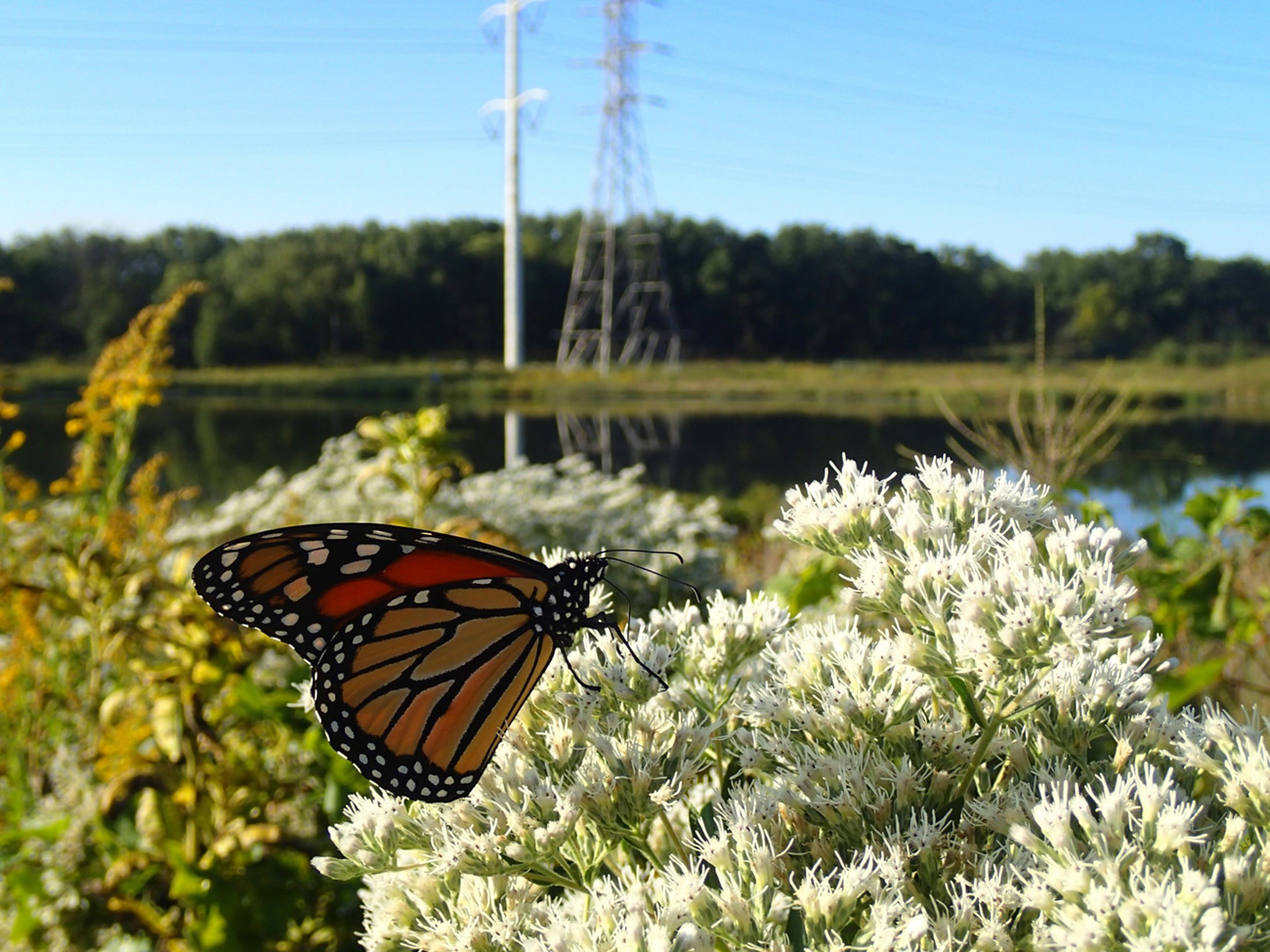
Our vision is to establish a legacy of sustained economic growth, social responsibility and environmental stewardship representative of a premier energy company. As stewards of the environment, we commit to conserving and enhancing biodiversity on lands under our responsibility. NiSource practices environmental stewardship by reducing our impact on the environment through pollution prevention and reduction programs, and through innovative conservation approaches. We’re making significant investments to ensure that we can continue to deliver energy to our customers where and when they need it, and in a way that is environmentally responsible.
NiSource Utility Vegetation Management
NiSource manages six electric and natural gas companies across Midwestern and Mid-Atlantic states. Our operating companies include the Northern Indiana Public Service Company (NIPSCO) and the Columbia Gas companies of Kentucky, Ohio, Pennsylvania, Virginia and Maryland.
We manage energy generation facilities and transmission and distribution infrastructure across a large, diverse landscape. Our geographic footprint of owned lands and easements covers approximately 135,000 acres.

Overhead electric transmission (NERC-regulated extra high voltage, 200kv+): 475 miles*
Overhead electric distribution (non-NERC-regulated): 10,780 miles*
Underground natural gas pipeline: 55,700 miles*
* NiSource does not manage every line mile; only where vegetation exists in a natural, undeveloped state that requires maintenance.
Utility Vegetation Management Research Trends
In the 1980s and 1990s, academic research emerged concerning habitat fragmentation for caribou herds in Alaska and other potentially negative effects that utility infrastructure may have on undisturbed habitats and native wildlife in Australia. This research
left a legacy perception that utility rights-of-way only fragment habitat, providing little value to their surrounding landscapes and ecosystems. While it can be true that long, linear corridors that transect core, contiguous habitat areas, can contribute
to habitat fragmentation for large charismatic wildlife, like caribou, linear rights-of-way can also act as wildlife corridors providing food, cover, and breeding habitat for numerous birds, insects, and mammals, if managed properly through integrated
vegetation management. 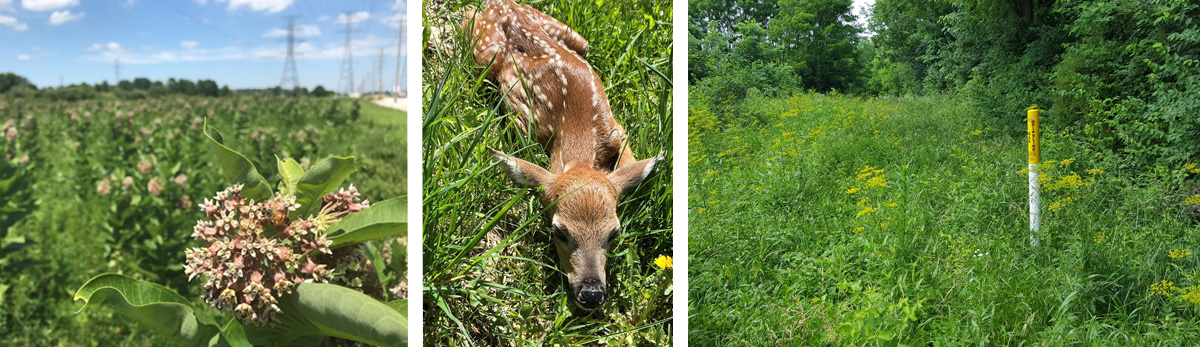
Pictured above: Common milkweed, fawn, forested pipeline, NIPSCO right-of-way
In response to public concern about the
excessive use of herbicides in the 1950s, the longest running research and demonstration study on the effects of utility vegetation management began in 1953 in Pennsylvania on State Game Lands 33. Research on this site, and others like the Green Lane
Research and Demonstration Area, have continued to study the effects of various non-selective and selective integrated vegetation management methods on vegetation and wildlife habitat quality. Following more than six decades of ecological research, academic
researchers and utility vegetation management practitioners continue to conclude that integrated vegetation management is the most cost-effective and environmentally-sound system to safely secure utility infrastructure while providing ecological benefits
to the surrounding landscape.
Integrated Vegetation Management
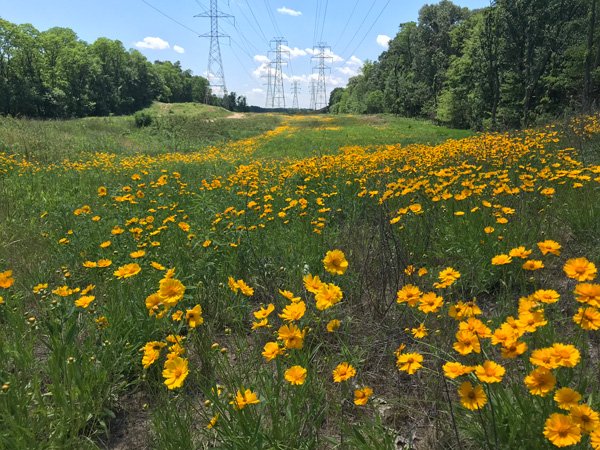 Pictured above: Sand Coreopsis, NIPSCO right-of-way
What is IVM?
Integrated vegetation management is “a system of managing plant communities in which compatible and incompatible vegetation are identified; action thresholds are determined; tolerance levels are
established; and control methods are evaluated, selected, and applied to achieve management goals and maintenance objectives.”
Why are Grassland and Shrub-Scrub Habitats Important?
Grasslands and shrub-scrub habitats are desirable vegetation communities because they provide biological control on our owned and leased lands that protect our infrastructure from coming into contact with incompatible tall-growing woody species
that can cause damage or outages. Grasslands and shrub-scrub habitats are not only desirable from a safety and reliability perspective, they are also two of the most threatened and rapidly disappearing ecosystems in North America, providing wildlife
habitat for numerous birds, mammals, and pollinating insect species.
Understanding Biodiversity-Related Risk
In 2022, NiSource formed a Biodiversity Team, comprised of internal and external subject matter experts, to evaluate the risks, impacts, and opportunities that biodiversity-related issues have across our business operations. NiSource’s 2022 Biodiversity Risk Assessment was performed using the Task Force for Nature-Related Disclosures LEAP approach (locate, evaluate, assess, prepare), supplemented by biodiversity management and material topics defined by the Global Reporting Initiative and the Dow Jones Sustainability Index. The scope of our Biodiversity Risk Assessment includes owned and leased operations, lands adjacent to owned and leased operations, and upstream activities like forest products utilized to protect natural resources during construction (mats) and to distribute energy to our customers (poles).
Leveraging the results of the 2022 Biodiversity Risk Assessment, NiSource’s Biodiversity Team developed a long-term strategy and tactical plan to address biodiversity-related risks and to enhance management of biodiversity across our extensive network of owned and leased lands. NiSource’s Corporate Biodiversity Strategy is built on two goals:
- Creating net positive impact on biodiversity
- Strengthening communities through our connections with nature
Activities that comprise NiSource’s long-term Corporate Biodiversity Strategy align with 2030 targets outlined within the Kunming-Montreal Global Biodiversity Framework of the Convention on Biological Diversity and specifically target:
1: Plan and Manage all Areas To Reduce Biodiversity Loss,
6: Reduce the Introduction of Invasive Alien Species by 50% and Minimize Their Impact,
10: Enhance Biodiversity and Sustainability in Agriculture, Aquaculture,
Fisheries, and Forestry,
11: Restore, Maintain and Enhance Nature’s Contributions to People,
12: Enhance Green Spaces and Urban Planning for Human Well-Being and Biodiversity,
14:
Integrate Biodiversity in Decision-Making at Every Level,
15: Businesses Assess, Disclose and Reduce Biodiversity-Related Risks and Negative Impacts,
21: Ensure That Knowledge Is Available and Accessible To Guide
Biodiversity Action.
Biodiversity Exposure, Assessment and Management Plans
NiSource’s Biodiversity Team continually evaluates our understanding of the opportunities that our business operations provide to maintain and enhance biodiversity. In 2019, NiSource undertook our first company-wide evaluation of energy generation, transmission and distribution lands for protected areas classified by the International Union for the Conservation of Nature (IUCN), Key Biodiversity Areas (KBAs), and critically endangered, endangered and vulnerable IUCN Red List Species. Results of this evaluation helped us to better understand direct and indirect impacts of our actions, to develop biodiversity management plans for high biodiversity areas, and to enhance conservation activities for sensitive species.
In 2024, NiSource revised our biodiversity exposure evaluation using updated data describing our owned and leased properties, as well as updated external data delineating protected areas, biologically important areas outside of protected areas, and potential habitat for sensitive wildlife species.
NiSource does not operate in World Heritage areas. However, where we share management responsibilities with our partners at globally and nationally important, protected areas (IUCN II-IV), we employ a mitigation hierarchy to protect sensitive habitats and species. Results of our 2019 biodiversity exposure evaluation were used to develop 26 biodiversity management plans for areas of high biodiversity value (IUCN II-IV & Key Biodiversity Areas). In 2019, NiSource developed the target to complete all twenty-six biodiversity management plans by 2023, and we achieved this target. Biodiversity management plans are maintained and updated periodically according to our vegetation maintenance schedule.
Mitigation Hierarchy
Our commitment to biodiversity is achieved through application of a mitigation hierarchy that applies to each aspect of asset development, operation, and maintenance. Our planning framework is designed to avoid new development in globally and nationally important biodiversity areas, to minimize and restore unavoidable negative impacts from operations, and to offset any remaining impacts within biologically sensitive areas. NiSource uses this framework to manage biodiversity-related risks and to balance sustainable management of natural resources with development priorities.
Avoid
Avoidance typically applies to project siting, design, and scheduling. NiSource avoids siting new infrastructure in globally and nationally important biodiversity areas, as well as regionally and locally important areas like native prairies, savannahs and wetlands. Careful siting of infrastructure, selection of best management practices (BMPs), and seasonal scheduling can greatly reduce and, in some cases, avoid negative impacts to biodiversity and natural resources.
Reduce
NiSource practices a variety of reduction activities across our business operations. NiSource’s hydroelectric generation facilities in Northern Indiana follow protocols developed in coordination with the US Fish and Wildlife Service to reduce negative downstream effects on federally endangered mussels during abnormally low flows on the Tippecanoe river. This example is described in greater detail within the No Net Loss and Net Positive Impact section below.
Regenerate
NiSource’s IVM program focuses on selective removal of incompatible, tall-growing woody species that threaten electric and natural gas infrastructure. Selective treatments limit off-target effects to the surrounding, compatible vegetation, like milkweeds and nectar-bearing forbs, that provide ecological value to birds, mammals, and pollinating insects. As opposed to traditional utility vegetation management, which may focus on non-selective vegetation maintenance method’s, NiSource employs IVM which is a regenerative system of management that seeks to establish, maintain, and enhance biological control by low-growing, compatible, wildlife-friendly plants on the lands that we manage.
Restore
As opposed to our IVM program, restoration activities are most often projects.
The Calumet Prairie State Nature Preserve and adjacent NIPSCO rights-of-way contain the largest natural sedge meadow and wet prairie community complex in Indiana. The wetland complex contains one of the largest populations of spotted turtles (Clemmys guttata) in the state of Indiana as well as numerous other state-listed species. In 2011, NIPSCO partnered with the DNR and U.S. Army Corps of Engineers to restore 144 acres of wetlands including 25 acres on NIPSCO right-of-way. The project restored structural function and ecological integrity of the sedge meadow through the removal of invasive species and undesirable woody vegetation. In 2019, NIPSCO supported an additional 30 acres of wetland restoration within the preserve to compliment Corps activities. These additional restoration activities included invasive species control and native plant introductions on 63-acres of adjacent rights-of-way and implementation of a Spotted Turtle Habitat Management Plan to protect and enhance the extent and population within the Calumet Prairie Complex.
Transform
NiSource’s Corporate Biodiversity Strategy, commitment to biodiversity, and commitment to IVM are transformative initiatives that secure our business operations from biodiversity-related risk, contribute to operational flexibility through innovative conservation activities, and provide positive examples that contribute to better management of utility lands. We don’t do this alone. We have learned from other industry leaders and we continue to work with and form new conservation partnerships to share the cost and responsibility of environmental stewardship.
No Net Loss and Net Positive Impact
 Pictured above: Norway Dam, Tippecanoe River, NiSource
NiSource avoids sourcing raw materials from and operating within areas of critical biodiversity, but it’s important to note that many areas classified for conservation of critical biodiversity were designated after the establishment of NiSource infrastructure.
NiSource recognizes that hydroelectric facilities, while providing renewable energy, can pose threats to biodiversity, particularly aquatic fauna. During normal run-of-river operations for our Oakdale and Norway hydroelectric dams in northern Indiana, both established before federal energy policy and designation of critical habitat, NiSource, pursuant to regulations of the North American Electric Reliability Corporation and the US Fish and Wildlife Service, minimizes water withdrawals during abnormally low flows and lake levels to protect federally listed mussels on the Tippecanoe River.
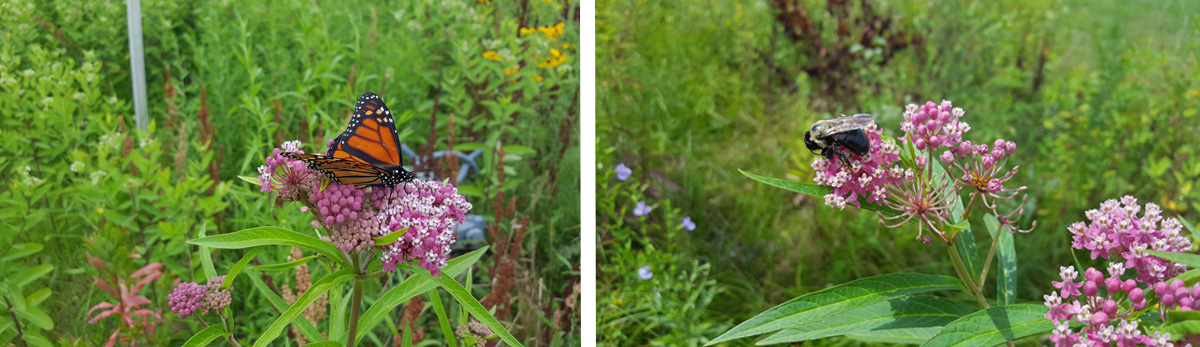 Pictured above: Monarch butterfly and bumblebee on Common Milkweed, Columbia Gas right-of-way
Recognizing that global biodiversity loss poses threats to ecosystem services and our own operational flexibility, NiSource was a founding member and maintains a certificate of inclusion within the Nationwide Candidate Conservation Agreement for Monarch Butterfly on Energy and Transportation Lands. NiSource’s certificate of inclusion ensures that NiSource will continue normal IVM practices on our generation, transmission, and distribution lands should the US Fish and Wildlife Service list the monarch butterfly as threatened or endangered. In exchange for long-term operational flexibility, NiSource commits to implementing conservation measures on lands that we manage to conserve milkweed and other nectar-bearing floral resources that support monarch butterfly habitat, and to assess monarch habitat quality through annual monitoring. Through this agreement, NiSource commits to no net loss, and where feasible, works to enhance habitat resources for net positive impact on the monarch butterfly on the owned and leased lands that we manage for energy generation, transmission, and distribution.
Proactive Ecosystem Conservation
NiSource is currently developing a formal no net deforestation policy, expected to achieve no net deforestation of mature and old-growth forests by 2030. Our planned no net deforestation plan will be monitored by NiSource’s Environmental Permitting Department for evaluation and net compensation planning.
No Net Deforestation
NiSource considers the term deforestation to mean the purposeful clearing of mature or old-growth forests.
NiSource accepts the Bureau of Land Management’s definition
of mature forests as,” the stage of forest development immediately before old growth. The mature stage generally begins when a forest stand moves beyond self-thinning, and is often marked by abundance of large trees, vertical canopy layers,
aboveground biomass accumulation and stand height, as well as other attributes,” whereas, old-growth forests are defined as, “dynamic systems distinguished by old trees and related structural attributes. Old growth encompasses the later
stages of stand development that typically differ from earlier stages in a variety of characteristics, which may include tree size, accumulations of large dead woody material, number of canopy layers, species composition and ecosystem function.”
NiSource does not consider the following IVM activities to be deforestation:
- Reclamation activities that involve the clearing of immature shrubs and trees to maintain right-of-way widths,
- Tree trimming of forest edges to maintain right-of-way widths and clearance distances between woody vegetation and electric conductors,
- Maintaining low-growing grassland and shrub-scrub habitats through the selective control of immature tree saplings and woody vines that threaten utility infrastructure.
No Net Deforestation Mitigation Hierarchy
The majority of NiSource’s owned and leased rights-of-way are maintained in low-growing grassland and shrub-scrub cover types that provide for the safe and reliable transmission
and distribution of energy.
When siting new infrastructure, NiSource avoids siting rights-of-way through mature and old-growth forest due to the increased operational challenge and costs associated with clearing forested lands. Where
avoidance is not possible, NiSource mitigates and minimizes the effect of fragmentation on core forested habitat by siting along paths that reduce core habitat fragmentation. Where mitigation and minimization are not possible, NiSource invests in
reforestation and afforestation projects (restoration), as well as urban tree planting projects that help to compensate for the loss of mature and old-growth forests.
NiSource is currently developing a formal no net deforestation
policy, expected to achieve no net deforestation of mature and old-growth forests by 2030. Our planned no net deforestation plan will be monitored by NiSource’s Environmental Permitting Department for evaluation and net compensation planning.
Sustainable Forest Resource Tier-1 Suppliers
Sustainable Electric Pole and Wooden Mat Supply Chains
In addition to NiSource’s planned no net deforestation policy, 100% of NIPSCO
overhead electric wooden distribution poles and wooden construction mats are sourced from suppliers that utilize sustainable forestry practices.
Engagement with Partners
NiSource regularly engages with stakeholders and community partners on a wide range of environmental and conservation initiatives throughout our service territory. External stakeholders include local and national environmental non-profits, state and federal agencies, environmental consultants, customers and local communities. By leveraging NiSource resources and personnel, we often extend conservation and biodiversity protection well beyond our fee owned lands and managed rights-of-way.
In Indiana, for example, NiSource has helped secure private, state and federal grant dollars for integrated vegetation management, pollinator habitat restoration and landscape-level habitat restoration projects within co-managed and adjacent protected areas. NIPSCO is also restoring over 1,000 acres of electric and natural gas pipeline transmission rights-of-way for key biodiversity areas. Conservation goals for these projects include the protection of plant species of greatest conservation need (SGCN); enhancement of sedge meadow, wet prairie, and upland sand prairie habitats; enhancement of wildlife SGCN species such as the spotted turtle and eastern massasauga rattlesnake; and protection of diverse wetlands and remnant native plant communities. NiSource is also controlling large invasive species populations adjacent to protected areas and enhancing pollinator conversion areas, such as mowed turf grass, old fields, and agricultural lands via collaborative efforts.
Columbia Gas has established pollinator habitat sites in Virginia, Ohio, and Pennsylvania, collaborates with the Audubon Society of Southwestern Pennsylvania, the Pennsylvania Department of Transportation, the University of Kentucky, Lexington Parks and Recreation, and other private businesses to provide conservation benefit.
Our continuing efforts are improving engagement between staff and our community partners, or our culture of environmental stewardship, and contributing to enhanced wildlife habitat quality across NiSource’s large service territory.